
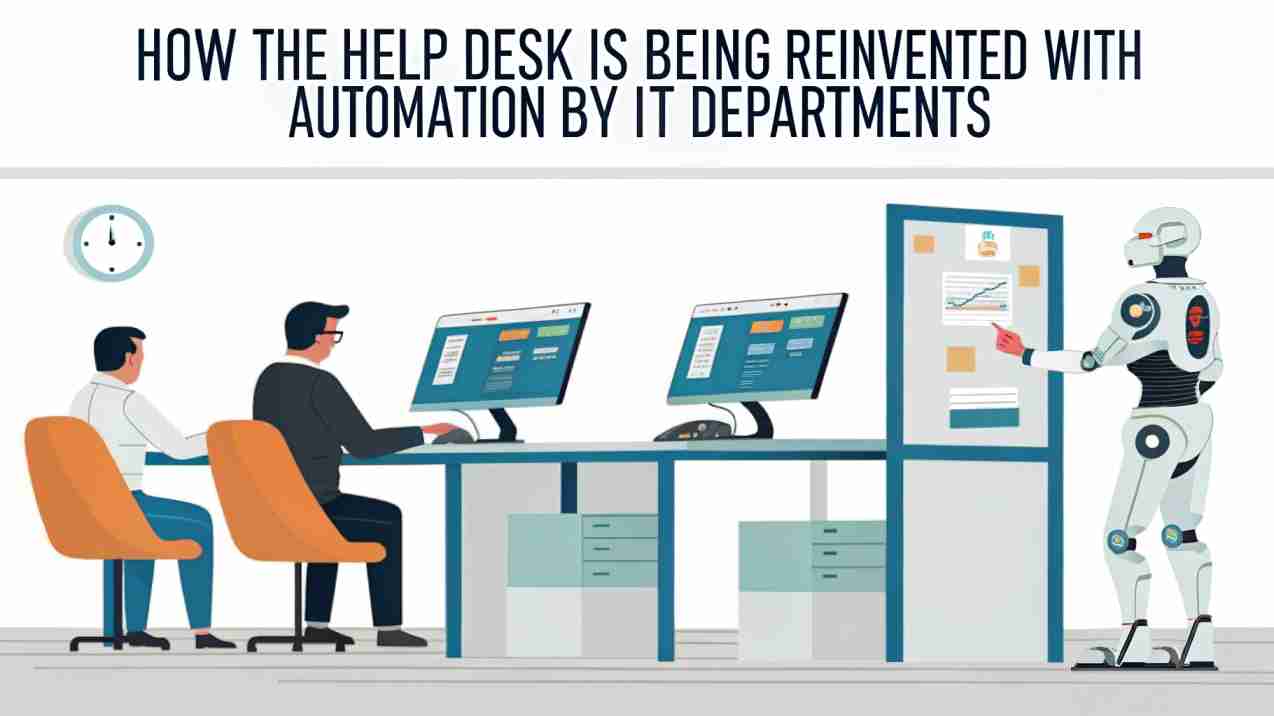
How the Help Desk is being reinvented with automation by IT Departments
The IT help desk is not a new concept in the office. You lose your password, you make a call to the help desk. Your computer crashes, and you put in a ticket. You require a new software license; you stand in line. It is a system that functions – but it is slow, costly, and frustrating to all involved. That is evolving rapidly, with IT departments automating their support of employees to totally transform the way they offer it.
The Old Way
Conventional help desks are very dependent on human agents, who process requests individually. A problem is recorded by an employee, a technician is assigned the problem, the technician examines the problem, asks follow-up questions, implements a fix, and closes the ticket. This process may take hours or days, even in the case of simple problems.
The amount of work is enormous. The help desk receives thousands of tickets every month at any large company. A massive amount of them are repetitives: resetting passwords, updating software, requesting access, and printer issues. Skilled technicians waste a considerable amount of their time doing jobs that do not require their skills.
Enter Automation
All this is being changed by automation. The use of AI, chatbots, and even automated workflows within modern IT departments is now taking care of a significant amount of requests without any human intervention.
To illustrate, one of the frequent requests of the help desk is to reset passwords, which can now be fully automated. A worker goes to a self-service portal and identifies themselves using security questions or a second device, and the system immediately resets the password. No ticket, no wait, no one required.
The IT support of the future is now chatbots with artificial intelligence. In the case of a problem with an employee, he or she initiates a chat with a chatbot, which requests him to explain the problem. The chatbot compares the description to a database of common solutions and either guides the employee through a solution or refers to a human technician in case the issue is complicated.
The Benefits
The outcome has been magnificent. Companies that have implemented automated help desks claim to have reduced the time of resolving their problems, lower costs, and an increase in employee satisfaction. An issue that once took two days to solve can now be solved in a two-minute period throughout the day and night, even during weekends.
Technicians do not do the same things over and over again and are able to concentrate on complicated and involving issues that do demand their expertise. This introduces additional satisfaction to the job and decreases burnout.
The savings in cost are considerable in business terms. It is possible to process a lot more requests with automated systems at a fraction of the rate of having a full staff of help desk.
Challenges to Consider
Automation has some challenges. The establishment of these systems involves the large upfront cost in terms of time and money. The chatbot requires a knowledge base that drives it; without proper answers in the database, the chatbot will provide poor advice.
Not all problems are automatable. The complicated problems that require the use of unusual configurations, sensitive information, or unusual groupings of factors still require a human touch. The difficulty is in coming up with a system that understands when to escalate and does so in a very short time.
It also has a change management challenge. The workers, accustomed to addressing someone, might not be ready to change to chatbots. It is necessary to communicate well, train workers, and demonstrate to the employees that the new system is indeed faster.
The Future of IT Support.
The help desk is being reshaped into an active, automated service engine rather than a reactive system that is based on tickets. The systems will be improved as AI advances to predict problems even before they occur, and contact employees before they even notice that something is wrong. IT support of tomorrow is smarter and quicker, and it is always there.